Hardware + Software + Service Design
IoT Service Design project
Sustainable Utilization of Group Study Rooms




Overview
- Sustainable utilization of group study rooms at Umeå University prototype through service design + IoT hardware + web app.
- This project was developed in the course "Service development and design for the Internet of Things".
- Duration: ~1 month on 50%, 4 person team.
Problem
Group study rooms are a high-demand campus resource, yet they are frequently underutilized due to a disconnect between digital bookings and physical activity. Students often reserve rooms days in advance for longer periods than necessary, which results in rooms remaining empty while appearing "unavailable" to others. This inefficiency is compounded by a current cancellation process that is difficult and inaccessible, preventing unused time slots from being released to students who need them on short notice.
Summary
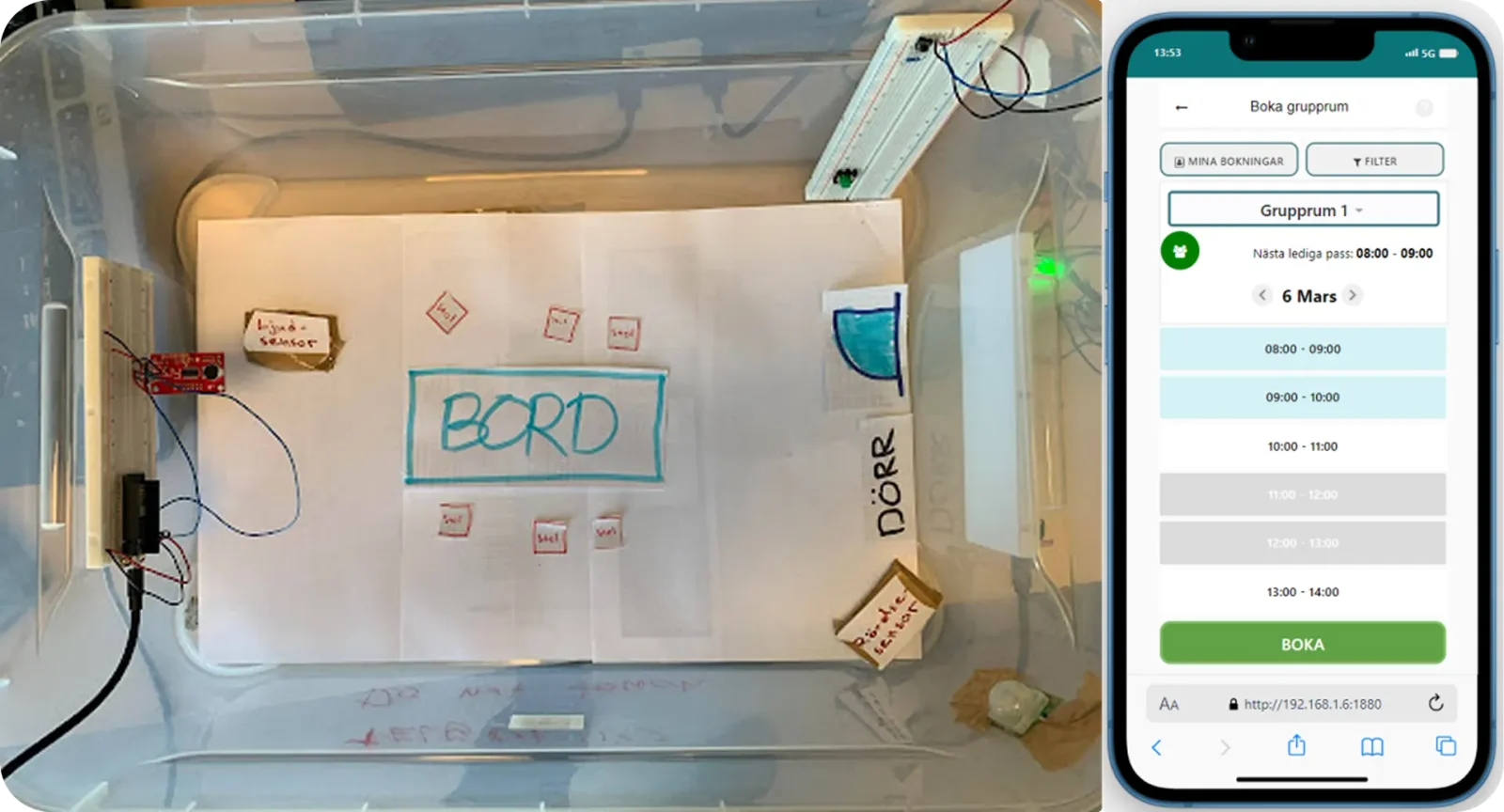
- Developed a functioning prototype using python, Node-RED and raspberry pi.
- Audio sensor + motion sensor
- Button and light
- All programmed/connected to the application.
- Received high praise from the faculty
My key contributions were the idea of the project problem, service design, core UX, web app development, MQTT programming, and some Node-RED flows.
Interactions and system design
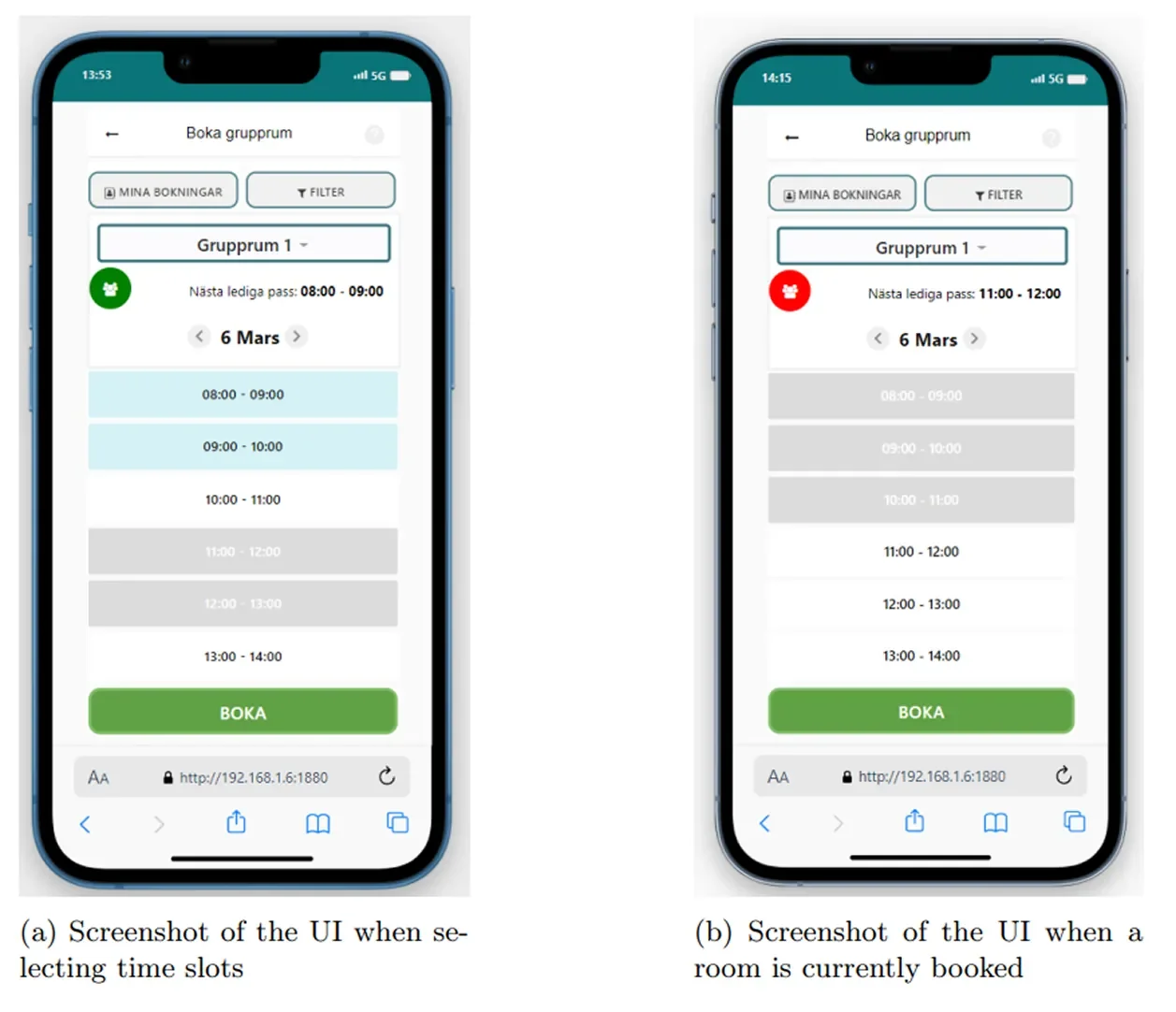
Application: the primary method for booking a room is through a digital web application where users select a room, timeslot, and input their their email address.
The system has both physical and digital interactions that complement each other, creating a flexible, emergent system designed to maximize sustainable room utilization.
Cancelling an ongoing booked session should be as easy as possible in order to prevent rooms from sitting empty while "booked", so other students may use them. To ensure sustainable usage, the system has three cancellation methods:
- Physical Button: A button inside the room allows for the immediate cancellation of an ongoing session, resulting in smooth UX and reduces reliance on the web app.
- Digital Interface: Users can cancel via the application by entering the email used during the booking process
- Automatic Triggers: If a room remains inactive for a specific period, the system automatically cancels the booking to make the room available for others.
Status indicators
The system visualizes room availability through both the digital application and a physical LED diode placed outside the room. This dual approach helps students find study spots efficiently, even without relying solely on the application. The room status is categorized into three states:
Green:
Available
Yellow:
Busy but not booked
Red:
Booked
Why the yellow status?
- This offers the ability to use a room for quick, spontaneous or shorter periods of time, without having to book it online, which results in better UX.
Why the LED diode outside the room?
- Students walking and scouting for empty rooms can easily see if a room is empty and unbooked, without having to check the web app for a room's status.
- Attracts students to underutilized spaces and allow for spontaneous use without requiring constant digital interactions.
The course's focus were solely on technical implementation and NOT UX/UI